Claude Mythos 5.5 Leak: What the Reported Sighting Means for Your AI Stack
A reported mention of Claude Mythos 5.5 on Anthropic's Mythos page has people asking whether to change their AI setup. Anthropic hasn't confirmed anything, so here is what to do now and what to leave alone.
Category: Engineering

If you build with AI or run a business on top of it, a headline like "Mythos 5.5 spotted" raises a fair question: do I need to change anything? For almost everyone, the answer today is no. There are still a few cheap things worth doing this week so a new release doesn't catch you off guard.
Everything about Mythos 5.5 below is reported, not confirmed. Anthropic has not announced it.
What was reported, and what wasn't
On 1 November 2026, the site TestingCatalog reported that a hidden mention of "Claude Mythos 5.5" had been spotted on Anthropic's official Mythos page. Here is how the reporting breaks down.
Reported:
- The mention was hidden on the Mythos page. It reportedly carried little more than a version number.
- It was not in an archived snapshot of the page from 23 October, which suggests it was added recently.
- It was later reportedly gone. Some outlets that checked the live page afterwards said it still showed 5.1 and no 5.5 string.
- A "Claude Fable 5.5" name was reportedly seen in A/B tests with selected users.
Not known:
- Whether Mythos 5.5 or Fable 5.5 will launch at all, and under what name.
- Any release date. A launch "next week" is speculation based on a name on a page. It is not something Anthropic said.
- Specs, benchmarks, pricing or who would get access. Nothing was published.
A reference in a page's code can be a staging artifact, a template leftover or a plan that changes. Treat it as a hint and don't plan around it.
Quick background: Mythos vs. Fable
The naming is confusing, so here is the short version.
- Anthropic released Claude Fable 5.1 and Claude Mythos 5.1 on 1 September 2026.
- Anthropic describes them as the same model with different levels of safeguards.
- Fable is the public version. Anyone can use it, and it has more safeguards.
- Mythos is gated. It is only for verified organisations in cybersecurity and life sciences, through Anthropic's trusted-access programmes. Its safeguards are built for that work.
So if the leak is real, a Mythos release would matter most to security teams and life-science researchers who can get verified. A Fable 5.5 would matter most to everyone else. That second part is the less certain one, because it rests on A/B-test reports.
What this means for your business
Your situation decides how much attention this deserves.
| Your situation | Does this affect you now? | What to do |
|---|---|---|
| You use a general-purpose Claude model for chat, content, support or coding help | No | Keep going. Add a release-watch habit (see below). |
| You have an automation or product built on the API | Not yet | Make sure the model name is a setting, not hard-coded. |
| You are a verified cyber or life-science user | Possibly | Watch official channels and your programme contact. |
| You are not verified but wonder if you can get Mythos | No | Don't plan around access you don't have. |
| You are choosing an AI vendor right now | Not a reason to wait | Choose on current, tested performance. |
There is always a newer model coming. Waiting for the next release before building usually costs more than building on what exists and designing for a swap.
What to do this week
These steps take hours, not weeks, and they pay off whether or not 5.5 ships.
1. Find every place a model name is written
Search your code, config files, no-code tools and automations for the model ID you use. If it appears in ten places, put it in one config value or environment variable. Changing models should be a one-line edit followed by testing.
2. Build a small test set
Collect 20 to 50 real examples from your own work: support questions, documents to summarise, code tasks, whatever your product does. Write down what a good answer looks like. When a new model appears, you can run this set against it and compare results in an afternoon. Without it you are guessing.
3. Log cost and quality for your current model
Track tokens used, cost per task, error rate and how often a human has to fix the output. These numbers are what you compare against when a new model arrives. Vendor claims about price and quality are averages from the vendor's own tests. Your numbers are the ones that count.
4. Read the migration notes for the version you're on
Model upgrades in this generation have come with API changes. Anthropic's Fable 5.1 documentation, for example, lists breaking changes, including no support for forced tool use. If you haven't read the notes for the version you run, do it now. You will want to know what breaks before a newer version arrives.
5. Set up a release-watch routine
Subscribe to the vendor's official announcements and API changelog. Follow one or two trackers for early signals, but treat them as signals only. A five-minute weekly check beats reacting to every post.
What not to change yet
- Don't switch production models on a rumour. There is no model to switch to yet, and a model with no documentation can't be tested.
- Don't rewrite prompts for a model you haven't seen. Prompts tuned for imagined behaviour tend to need redoing.
- Don't announce AI roadmap changes to customers or your board. If you tell people a new capability is coming and it doesn't, you lose credibility.
- Don't change contracts or budgets on speculation. Pricing for 5.5 hasn't been published.
- Don't assume you'll get Mythos access. It is restricted to verified users. Plan on Fable-class models unless you are in one of those programmes.
Build so a new model is a non-event
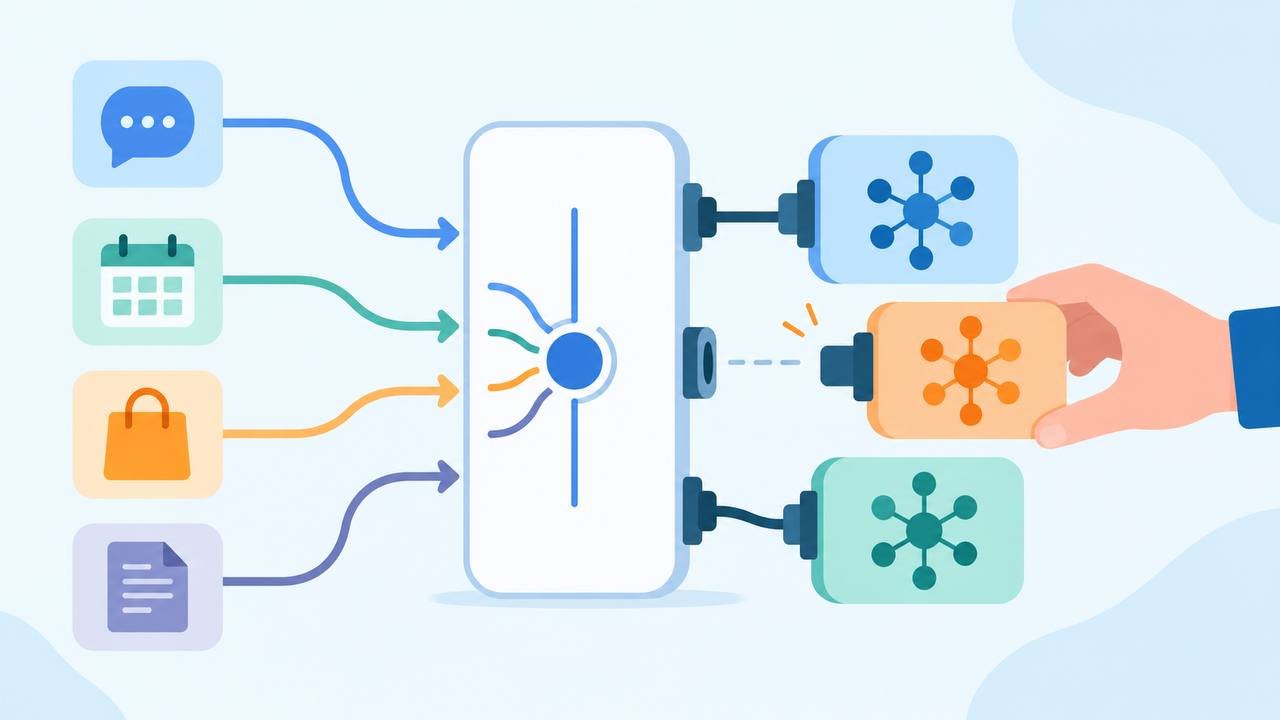
The businesses that handle model releases well did the boring work earlier. Their AI calls go through one layer in the code that handles the model name, retries, logging and fallbacks. If you're new to how these connections work, our explainer on what an API is covers the basics.
A sound setup has these parts:
- One AI gateway in your backend. Every feature calls it. No feature calls the vendor directly.
- Model names in configuration. Different tasks can use different models, such as a cheaper one for simple classification.
- A fallback. If the main model fails or is rate-limited, the system tries a second option or degrades gracefully.
- Logged inputs and outputs, with privacy rules. You can replay real traffic against a new model.
- Feature flags. You can send 5% of traffic to a new model, watch the results, then widen the rollout.
This is backend work, and it is the kind of thing a well-built software system and API layer is meant to give you. If your AI features are scattered across scripts and tools with no common layer, consolidating them is worth doing before the next model arrives. Aneta Prime builds this kind of backend if you want a second pair of hands.
If Mythos 5.5 or Fable 5.5 does launch
Wait for the official announcement, then work through this checklist.
- Read the official post and docs first. Check the model ID, availability, pricing and any breaking API changes.
- Check access. Is it public, gated or limited to certain regions or organisations?
- Run your test set. Compare quality and cost against your current model at the same settings.
- Test the edge cases that hurt you before. Long documents, tool calls and anything your users complain about.
- Roll out gradually. Use a feature flag, watch logs for a week, then decide.
- Keep the old model available. Vendors usually keep earlier versions for a while, so check the published support dates and keep your fallback until you're sure.
If Mythos 5.5 follows the same gating as 5.1, most teams will stay on the models they already run. That is also a guess, so don't plan around it.
How to read leak stories
This episode is a good example of how to judge AI rumours.
- Check who is reporting. Is it a screenshot, an archive check or a hearsay post?
- Look for confirmation from the vendor. Official blogs and docs count. Social posts don't.
- Notice the gap between "a name appeared" and "a product ships". Many names appear and never launch as described.
- Be wary of invented detail. If a post lists specs or benchmarks for a model nobody has seen, it is made up.
Bottom line
The reported Mythos 5.5 mention is a signal that something may be coming. It is not a reason to rebuild anything today. Use the time to make your setup easy to change: one gateway, model names in config, a test set and a watch routine. When Anthropic says something official, you can test and decide in a day, not panic for a week.
Tags: claude, anthropic, ai models, mythos, fable, ai for business, api integration